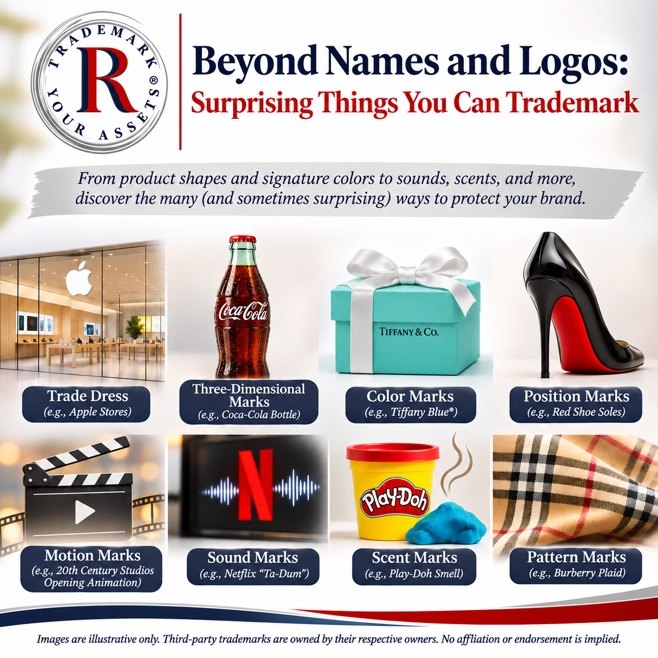
When most people think of trademarks, they think of business names, logos, and slogans. But did you know that you can also trademark the shape of a product, a particular color, a sound, or even a smell?
Trademark protection extends well beyond traditional branding. Businesses can sometimes protect unique features that customers immediately associate with their products or services.
Let's explore seven unconventional types of trademarks, along with some recognizable real-world examples.
What Is Trade Dress?
Before exploring unconventional trademarks, it’s helpful to understand trade dress.
Trade dress is the distinctive visual appearance of a product, its packaging, or even a business environment. It can include elements such as shapes, colors, textures, graphics, and overall design.
Unlike a traditional trademark protecting a name or logo, trade dress protects visual features that identify a particular brand.
To qualify for protection, trade dress must be distinctive and cannot consist of functional features. Depending on the type of trade dress, a business may also need to show that consumers associate its appearance with that business.
Real-World Example: Apple Stores
Ever walk into an Apple Store and immediately recognize its sleek, minimalist design? Apple has actually registered the distinctive layout of its retail stores as a trademark.
That's right, even the appearance of a store can be protected!
USPTO Registration No. 4,277,914 (View registration)
1. Three-Dimensional Trademarks: Protecting Product Shapes
A three-dimensional trademark protects the distinctive shape or configuration of a product or its packaging.
Think of a uniquely shaped bottle or container that consumers recognize even without seeing the brand name.
Product packaging can sometimes qualify for trademark protection based on its distinctive appearance alone. However, the shape of a product itself generally requires proof that consumers have come to associate that design with a particular brand.
This is known as acquired distinctiveness.
Real-World Example: The Coca-Cola Bottle
You probably know a Coca-Cola bottle when you see one, even without the label. But did you know its famous curved shape is a registered trademark?
Coca-Cola has protected its distinctive bottle design for decades.
USPTO Registration No. 1,057,884 (View registration)
2. Color Trademarks: Can You Own a Color?
Believe it or not, a particular color can qualify for trademark protection!
A business may be able to register a color when consumers have come to associate it with a specific brand.
However, a company cannot claim exclusive rights to a color simply because it uses it. The color must identify the source of particular goods or services and cannot serve a functional purpose.
Real-World Example: Tiffany Blue
Did you know Tiffany & Co. has trademark protection for its famous robin's-egg blue?
That little blue jewelry box is so recognizable that you probably know where it's from before you even open it!
Of course, Tiffany doesn't own every use of that shade of blue. Its trademark rights apply to particular uses associated with its brand.
USPTO Registration No. 2,184,128 (View registration)
3. Position Marks: It's All About Placement
Sometimes, what makes a trademark distinctive isn't just the design itself, but where it appears.
A position mark protects a recognizable feature placed in a specific location on a product or its packaging. This might include a stripe, color, or decorative element that customers consistently associate with a particular brand.
Trademark applications for these marks often use dotted or broken lines to show the product while identifying the specific feature being protected.
Real-World Example: Christian Louboutin's Red Soles
Those famous red-soled high heels? They're trademarked!
Christian Louboutin registered its distinctive red lacquered shoe soles when they contrast with the color of the upper portion of the shoe.
It's a great example of how something as simple as the placement of a color can identify a brand.
USPTO Registration No. 3,361,597 (View registration)
4. Motion Trademarks: Protecting Moving Images
Trademarks don't always have to stand still.
A motion trademark protects a distinctive movement or animation that consumers associate with a particular brand.
These marks are especially relevant in today's digital world, where animated logos and moving graphics frequently appear in advertisements, applications, and videos.
To register a motion trademark, applicants can submit a drawing depicting a single point in the movement or up to five freeze frames, along with a description of the animation.
Real-World Example: 20th Century Studios
Remember that dramatic movie introduction featuring the towering 20th Century Studios logo and sweeping searchlights?
That familiar animated sequence is actually a registered motion trademark!
USPTO Registration No. 7,350,678 (View registration)
5. Sound Trademarks: When Your Brand Can Be Heard
Not every trademark needs to be seen. Some can be heard!
A sound trademark protects a distinctive audio element that consumers recognize as identifying a particular brand.
Examples include jingles, short musical sequences, or recognizable sound effects.
Unlike visual trademarks, sound trademarks do not require a traditional drawing. Instead, applicants submit a recording and a description of the sound.
Real-World Example: Netflix's "Ta-Dum"
You know that familiar "ta-dum" sound when Netflix starts?
It's trademarked!
Netflix has federally registered its distinctive intro sound. Just a couple of notes, and you instantly know what you're watching.
USPTO Registration No. 5,194,272 (View registration)
6. Scent Trademarks: You Can Even Protect a Smell!
Can you believe that a smell can qualify for trademark protection?
A scent trademark protects a distinctive fragrance that consumers recognize as identifying a particular brand.
However, registering a scent is challenging. The fragrance must function as a brand identifier rather than a functional feature of the product, and the business must establish that consumers associate the scent with its particular goods or services.
Real-World Example: The Smell of Play-Doh
Remember that unmistakable childhood smell of Play-Doh? Well, it's a registered trademark! Hasbro registered the distinctive scent of Play-Doh, described as a sweet, slightly musky vanilla fragrance with hints of cherry and salted dough.
Who knew the smell of a childhood toy could become such a valuable brand asset?
USPTO Registration No. 5,467,089 (View registration)
But What About Perfumes, Colognes, and Air Fresheners?
If Play-Doh can trademark its smell, why can't a perfume company trademark its signature fragrance?
The answer comes down to functionality.
The primary purpose of perfume, cologne, and air fresheners is to provide a fragrance. Because the scent itself serves an essential purpose of these products, it is generally considered functional and cannot be registered as a scent trademark.
The distinction is important: a perfume company may be able to protect its brand name, logo, distinctive bottle shape, or packaging, but not the actual fragrance through trademark registration.
By contrast, when a scent is used on a product that doesn't ordinarily need one, and customers recognize that scent as identifying the brand, trademark protection may be possible.
That's what makes Play-Doh's registration so interesting!
7. Pattern Trademarks: Protecting Recognizable Designs
Did you know that even a repeating pattern can function as a trademark?
Distinctive patterns used on clothing, accessories, or packaging may qualify for protection when consumers recognize them as identifying a particular brand.
The key isn't simply having an attractive design. The pattern must serve as a brand identifier rather than merely decoration.
Real-World Example: Burberry's Signature Plaid
You know that classic tan, black, white, and red plaid? Chances are you immediately think of Burberry.
The company has registered its famous check pattern as a trademark.
It's a perfect example of how even a repeating fabric design can become a valuable brand asset.
USPTO Registration No. 1,241,222 (View registration)
How Do You Register an Unconventional Trademark?
Although unconventional trademarks take different forms, they all serve the same essential purpose: helping consumers identify the source of goods or services.
When evaluating whether a particular feature qualifies for federal trademark registration, several factors are important:
Distinctiveness: Do consumers associate the feature with your brand?
Functionality: Does the feature serve a practical purpose that competitors may need to use?
Trademark Use: Is the feature used to identify your business rather than simply decorate a product?
Application Requirements: Can the trademark be properly represented and described in an application?
Depending on the type of mark, registration may require drawings, detailed descriptions, audio recordings, or evidence establishing consumer recognition.
Because these applications can involve specialized requirements, identifying exactly what should be protected is particularly important.
Your Brand Is More Than Just a Name or Logo
As these examples demonstrate, a recognizable brand can involve much more than a name or logo. Everything from product packaging and colors to sounds and scents can contribute to how consumers identify your business.
And while not every distinctive feature qualifies for trademark registration, businesses may have valuable brand assets they haven't even considered protecting.
Is Your Business Overlooking Valuable Trademark Protection?
At Mortimer Legal, PLLC, we understand that your brand is one of your business's most important assets.
Whether you're developing a new brand, protecting an established one, or wondering if a unique product design, color, sound, or other distinctive feature qualifies for trademark registration, we can help you explore your options.
Contact Mortimer Legal, PLLC today to discuss your brand and how a thoughtful trademark protection strategy can help safeguard what makes your business unique.
This article provides general educational information about U.S. trademark law and is not legal advice. Trademark registrability depends on the specific name, its use in commerce, and the surrounding facts.