
If you’re an author, you probably spent a lot of time coming up with the perfect title for your book. So, of course, you want to protect it.
But can you trademark a book title?
Well, yes and no.
Generally, the title of a single book cannot be registered as a trademark for that book. But if that title is being used for a series of books, that can be a different story.
And even if you never plan to turn your book into a series, your book title may be able to function as a trademark for other goods or services you offer under that name.
Let’s break down the difference.
First, What About Copyright?
Copyright and trademark protect different things. Copyright protects original works of authorship, including literary works such as books. But copyright does not protect the title of your book. Names, titles, slogans, and other short phrases generally are not protected by copyright law.
Trademark law is different. A word, name, phrase, symbol, or design may function as a trademark when it identifies the source of particular goods or services.
So, while copyright may protect the original content of your book, trademark law may provide another form of protection for a name or title when that name is being used as a source identifier.
Why Can’t You Trademark the Title of a Single Book?
A trademark identifies the source of goods or services. It helps consumers recognize that certain goods or services come from a particular source.
The title of a single book, however, generally identifies the book itself, rather than the source of a series of books.
Publishing the same book in different formats doesn’t change that. A hardcover, paperback, audiobook, and e-book version are still different formats of the same creative work.
What If It’s a Book Series?
This is where things get more interesting, and one of my clients provides a great real-world example.
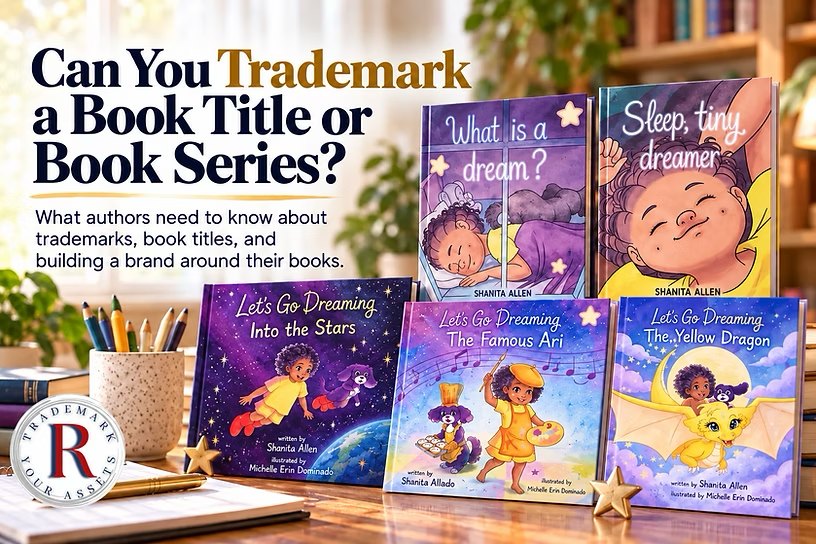
Children’s book author Shanita Allen created the Let’s Go Dreaming series, which follows Little Ari and her talking dog, Pepper, on adventures through the world of dreams. The series includes individual books such as Sleep, Tiny Dreamer, What Is a Dream?, Into the Stars, and The Famous Ari.
Each of these books is its own creative work with its own title. But LET’S GO DREAMING is the name that appears across the series and connects the individual books. That distinction is important from a trademark perspective.
An individual book title generally cannot be federally registered as a trademark for that single creative work. A series title can function differently. When readers encounter LET’S GO DREAMING across multiple books, the name can identify a series of distinct creative works coming from the same source rather than simply identifying one particular book.
LET’S GO DREAMING is a federally registered trademark, making it a good real-world example of the distinction between the title of an individual book and the name of a book series.
It is also important to understand what does not create a series. Publishing the same book in different formats does not turn a single creative work into multiple works for purposes of establishing a book series. For example, releasing the same title as a hardcover, paperback, e-book, and audiobook still gives you different formats of the same creative work. You need distinct creative works, not simply different versions or formats of the same book.
This is why authors who are planning a series should think not only about how many versions of a book they are publishing, but whether they are actually creating multiple, distinct works under a common series name.
What If I Know My Book Is Going to Be a Series?
You may publish your first book already knowing that you plan to release three, five, or even ten books under the same series name.
If only one book has been released, however, the USPTO may still view the title as the title of a single creative work. That doesn’t mean you should wait to think about trademark protection. If you know from the beginning that you’re building a series, it makes sense to think about your trademark strategy early. Depending on the circumstances, an Intent-to-Use trademark application may also be worth considering as part of that strategy.
What If You Don’t Plan to Create a Book Series?
Even if you never intend to publish a second book in a series, the title of your book may potentially function as a trademark for other goods or services offered under that name.
For example, perhaps you launch a podcast under the same name as your book. Maybe you develop educational or entertainment services around the book’s subject matter. Or perhaps the name becomes a brand for products such as apparel, mugs, toys, or other merchandise.
Depending on exactly what you are offering, relevant trademark classes could include downloadable digital content in Class 9, mugs and certain drinkware in Class 21, clothing in Class 25, toys in Class 28, or educational, entertainment, and certain podcast-related services in Class 41.
But there is an important distinction here. Simply printing the title of your book across the front of a T-shirt or putting it on a mug does not automatically turn the title into a trademark for those products. The name has to be used in a way that consumers would perceive as identifying the source of those goods or services, rather than merely as decoration, ornamentation, or a reference to the book.
So, the question becomes:
Are you using, or genuinely planning to use, the name as a brand for other goods or services?
If so, there may be additional trademark opportunities worth exploring even if the book itself will always remain a standalone work.
Make Your Series Look Like a Series
If you are building a book series, consistency matters. Think about how you are presenting the series name across your books, website, social media, marketing materials, and other places where readers encounter your brand.
Is the series name clearly and consistently displayed? Will readers understand that the books are connected? Are you using the series name in a way that helps consumers recognize it as identifying the source of multiple books rather than simply as part of the title of one book?
Those are important things to think about as you build your series.
Think Beyond the Book
This is something I think about quite a bit because I’m not only a trademark attorney. I’m also a children’s book author and I run a book production company.
A book may be where a brand begins, but it doesn’t necessarily have to be where it ends.
As an author, it helps to think about what you are ultimately building around your book. If your plans include a recognizable series, characters, merchandise, educational programming, licensing opportunities, or other extensions of the brand, those larger goals should be considered as part of your trademark strategy from the beginning.
Before You File, Make Sure the Name Is Available
Even if your series title, or the name you want to use for other goods or services, is capable of functioning as a trademark, that doesn’t necessarily mean the name is available for you to register.
Before filing a trademark application, it’s important to conduct a comprehensive trademark search. And that means looking beyond whether someone has registered the exact same name. Similar trademarks can also create problems depending on factors such as the similarity between the marks and the relationship between the goods or services. A comprehensive search can help identify potential conflicts before you invest even more time and money into building a brand around a particular name.
So, Can You Trademark Your Book Title?
The key is to look at how the title is being used.
A title identifying only a single creative work generally cannot be federally registered as a trademark for that book. A title identifying a series of books, however, may be capable of functioning as a trademark.
And a standalone book title may have trademark potential when the name is also being used as a source identifier for other goods or services.
So, instead of asking only, “Can I trademark my book title?” consider the bigger question:
What am I building around this name?
Your book may be where your idea starts. It doesn’t necessarily have to be where your brand ends.
Building a Brand Around Your Book?
At Mortimer Legal, PLLC, we help authors and other creatives think strategically about protecting the intellectual property they’re building.
If you’re developing a book series, or expanding a standalone book into merchandise, educational offerings, entertainment, licensing opportunities, or a larger brand, contact Mortimer Legal, PLLC today to find out how you can protect your book series, title or characters beyond copyright.
Click
here to schedule a discovery call to learn more.
This article is provided for general informational purposes only and does not constitute legal advice or establish an attorney-client relationship. For legal guidance tailored to your specific circumstances, please contact Mortimer Legal, PLLC directly to discuss how we may assist you.